A Beginners’ Guide to Buying Scottish Bagpipes

Buying a set of bagpipes is an exciting experience. However, there is often also some level of confusion, given the variety of bagpipes, and the differing information given by various sellers.
We will provide the process of deciding whether you are ready to buy a set of bagpipes, understanding what is in a set, choosing an appropriate brand and then assessing a product. By the end of this guide you will fully understand what you are buying and know what to avoid.
If you are interested in the background and traditions behind this instrument, you can also explore the history and cultural significance of bagpipes.
Are You Ready to Purchase a Set of Bagpipes?
Without exception, the honest response for the majority of people is currently no.
Most teachers will begin a student’s training on a practice chanter. This resembles a small flute and is far less noisy and simpler to manage than a full set. Students learn to play using this and to add embellishments (small additional notes which are key to producing the piping sound). Students also learn to control their breathing and to maintain a good steady beat.
Before purchasing a full set, students should therefore ideally be confident in their knowledge of all of these areas. Ideally, students’ fingers will move automatically and effortlessly and they should be able to play a selection of straightforward tunes.
Teachers are in the best position to advise students when they are ready to advance to a full set. They can assess their pupil’s development and determine whether their hands and breathing are adequately prepared for a larger instrument.
Unfortunately, purchasing a full set of Scottish bagpipes too soon can cause issues. As well as involving greater expense, they are more difficult to manage and students can become disheartened. Ideally, students should delay their purchase slightly so that they can then thoroughly enjoy their bagpipes.
Ready to Progress? Tick List
- Can I play a selection of basic tunes?
- Have my fingers become more fluid?
- Do I understand basic embellishments?
- Can I sustain a good steady beat?
- Has my teacher advised me that I am now ready to advance?
If you have answered ‘yes’ to most of these, then you are likely to be ready to begin your search for a set of bagpipes.
Understanding the Types and Materials Used
It is important that you understand the type and material of bagpipes that you are purchasing.
Great Highland Versus Scottish Smallpipes
Great Highland Bagpipes are the type of pipes which most people associate with Scottish music. Being quite loud, they are often played outside at parades and ceremonies. They are the traditional Highland pipes.
Scottish Smallpipes are significantly quieter. Generally, they are played within buildings and frequently accompany other instruments. Compared to Great Highland pipes, they are also more delicate and provide a slightly different playing experience.
Both pipe types are attractive, they differ in terms of the sound they produce, the method of playing and their purposes. Primarily, this guide centres around Great Highland Bagpipes as this is what most people wish to purchase initially.
For a broader comparison, you can also read about the key differences between Scottish and Irish bagpipes.
African Blackwood Versus Synthetic
For many years, African blackwood has been used in the manufacture of bagpipes. It is a natural, hard wood with an attractive grain. However, it does require specific care and attention to ensure it is maintained effectively and is not exposed to excessive humidity or drastic temperature fluctuations.
Synthetic pipes are produced from manufactured materials. Although they do not have a natural wood grain, they often have a uniform and polished appearance. Furthermore, they are generally easier to maintain and are far more tolerant of varying weather conditions.
Which type is more suitable? Again, this will largely depend on the individual. If you appreciate and wish to maintain natural wood then African blackwood is a good option. Alternatively, if you seek something which is more practical for regular tuition and you are not as concerned about the maintenance, then synthetic pipes can be an excellent choice.
Whilst the material can influence the sound of bagpipes, the manufacturing process, the reed configuration and the tuning are also highly significant.
How to Choose the Right Bagpipe Brand and Quality
Whilst it is important not to simply select pipes based on how attractive they appear in photographs, the actual manufacturing quality is of great importance.
There are several brands which are recognised and widely trusted by many pipers. These include McCallum, R.G. Hardie, Peter Henderson, David Naill and Duncan MacRae. Having existed for many years, these brands place a strong emphasis on high quality and good manufacturing.
Consideration should be given to:
- The pipes smoothly jointed? Does it feel sturdy?
- Is the set well-tuned? Good sets should retain good tuning.
- Are the pipes compatible with standard reeds? Compatibility is extremely important.
- Are spare components readily available? Further, does the seller provide good post-sales service?
Where possible, listen to samples of different brands to assess the sound. Indeed, each set will often have a slightly different sound. In addition, always consult your piping teacher or an experienced piper. As they have seen many different sets, they will be able to advise you on value for money.
Besides brand recognition, a good brand will consistently deliver high quality products. It will also provide good post-sales service and will supply items which can develop and adapt with you.
How Much Should You Spend on Your First Bagpipes?
Everyone will want to know how much to pay for a set of bagpipes. Unfortunately, there is no definitive answer to this.
Price will be affected by numerous factors. These include the type of material, the manufacturing quality and the type of embellishments (for example nickel, faux ivory and/or real wood) which are added. Alongside this, the range of items included in the set will also influence price.
Whilst deciding on a set, it is important to recognise the distinction between good manufacturing quality and ornamental value. Manufacturing quality relates to how well the pipes perform, how stable they are and their longevity. Ornamental value relates to visual appeal. With regards to initial purchases, good manufacturing quality is of greater importance.
In addition to the price of the pipes themselves, further expenditure is likely to be incurred on, for example, spare reeds, a case and maintenance items.
In order to effectively compare sets, it is advisable to compare whole sets rather than just price. Although one set may appear to be cheaper, if it fails to include reeds and/or a case this could in reality prove more costly.
As mentioned previously, prices fluctuate and will also differ from shop to shop. It is therefore a good idea to research and compare current listings from reliable sellers.
Should You Buy New or Second-Hand Bagpipes?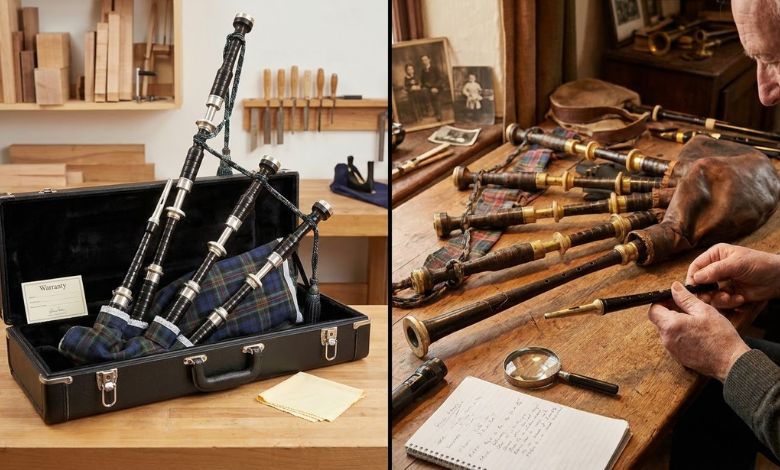
Both new and second hand sets can be appropriate choices. Each, however, has its own benefits and drawbacks.
Advantages of New Sets
- You are aware of the product’s condition and it is brand new.
- There may be a warranty applicable.
- Post-sales service is usually more easily obtainable.
- You can select the required material and embellishment type.
Benefits of Second Hand Sets
- They can be more economical.
- You may locate a good quality second hand set from a recognised brand.
However, there may be signs of wear and/or hidden maintenance requirements.
If you are considering second hand pipes, it is crucial that you thoroughly examine them for:
- Wooden cracks
- Mount and section condition
- Is the bag airtight?
- Reed state
- Pipe functionality (drones and chanter)
- History of maintenance and repair
Never attempt to buy second hand pipes without the advice of an experienced piper. Such an individual will be able to effectively evaluate the pipes for you and identify any potential issues which you may overlook.
What to Check Before Purchasing Your First Set
Prior to purchasing, spend a few minutes assessing the following points. This will help to avoid future issues.
- Is the set a complete and playable product?
- What reeds, bag and additional items are included?
- Have reeds already been inserted?
- Is the bag and blowpipe conveniently sized?
- Are spare components easily obtainable?
- What is the warranty? What post-sales service is provided?
- Are there sample sounds available?
- Is setup assistance provided?
If a seller is unable to clearly address these points then caution should be exercised.
What to Expect After Buying Your First Bagpipes
Following purchase, students will discover that playing bagpipes differs considerably from playing a practice chanter.
Initially, students must learn to regulate the air pressure in the bag. This is achieved by using the student’s arm to evenly compress the bag, in conjunction with their breathing. Although initially this can be unfamiliar, with practice it becomes more manageable.
Many teachers will teach students to initially play only the chanter, with the drones corked off. Students can then gradually introduce the drones, one at a time, under their teacher’s supervision, as they become more accustomed to managing the bag.
Students also receive instruction regarding tuning and reed adjustment. Occasionally, reed modification will be necessary and this is entirely normal.
Basic knowledge of how to clean and store pipes, together with humidity management, is also taught. Pipes should be kept dry and stored correctly. Following playing, cleaning should occur. Effective maintenance is often surprisingly simple.
Continual tuition and seeking ongoing guidance from your teacher is vital. However, do not attempt to speed up your progress. Although time consuming, proper development is highly rewarding.