Sgian-dubh Customs: Cultural Practices Surrounding Dirks
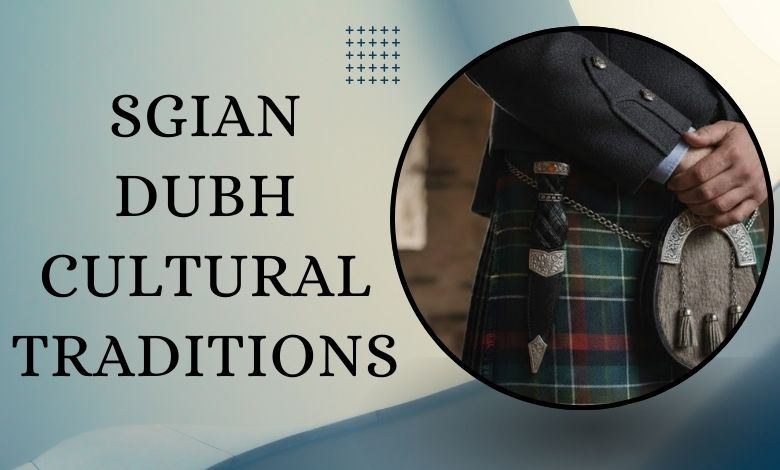
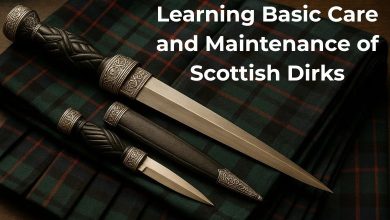
The sgian-dubh is a traditional Scottish dirk that is a part of ceremonial events today. In daily life, people use it for practical purposes, but its status changes when it is connected with traditional dress, the “kilt outfit.” When serving as a part of tradition, many cultural practices surround it, and this article is meant to explore them. So, without further delay, let’s begin.
Cultural Practices Surrounding the Scottish Dirk
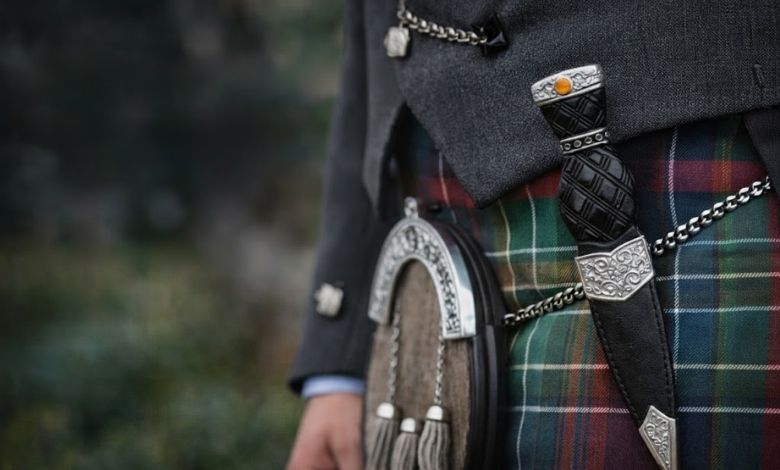
Regarding the use of Sgian-dubh in Scottish culture, we see it effective in several ways, from ceremonial uses to symbolizing honor and a respectful gift. Let’s proceed ahead to find their details.
Ceremonial Use in Highland Dress
The Scottish dirk was only a weapon for self-defense purposes, but the situation is different today. The sgian-dubh has a ceremonial use today, and it is often worn in formal settings, especially weddings and formal clan gatherings. Today, it serves as a decorative ornament rather than a practical tool.
Symbol of Honor and Valor
As we all know, the primary purpose of dirks was to work as a weapon, and in fact, they saved the lives of many in wars. So, the custom of keeping a Sgian-dubh symbolizes honoring the bravery and courage of forefathers. Wearing it during special events symbolizes keeping the memory of one’s ancestors close.
Highlight Clan Identity
The practice of having a Scottish dagger with your outfit helps you to expose your identity. Formal dirks are often engraved with clan crests or another symbol of the tribe. Even without asking, people can recognize your clan by seeing the design of your dirk.
Passing Down as a Family Heirloom
Across cultures, it is common to pass down valuable objects as symbols of family heritage. In nations that faced battles in the past, ancestral swords are given. Following the same criteria, Scots pass down Sgian-dubh as a family heirloom. Passing down a dagger connects generations with their forefathers and preserves cultural identity, as each piece is uniquely crafted to express individuality.
Ritualistic Presentation or Gift
One of the most meaningful traditional gifts at Scottish events is the exchange of Sgian-dubhs. This approach is pretty traditional at Scottish weddings, where the friends give it to the groom as a sign of heritage. Likewise, brides present grooms with Scottish dirks as a sign of love. The groom, on the other hand, keeps it to ensure that he will always protect his partner from tough situations.
Respectful Handling and Display
The traditional way of placing or displaying a Scottish dirk with an outfit is to tuck it into the top of the right hose. The way continues, and people still follow the same method to continue the tradition. Because of its unique design, the dirk can be challenging to handle properly. Traditionally, Scots handle the dirk using what’s known as an ‘ice pick grip.
The Sgian-dubh in Modern Times
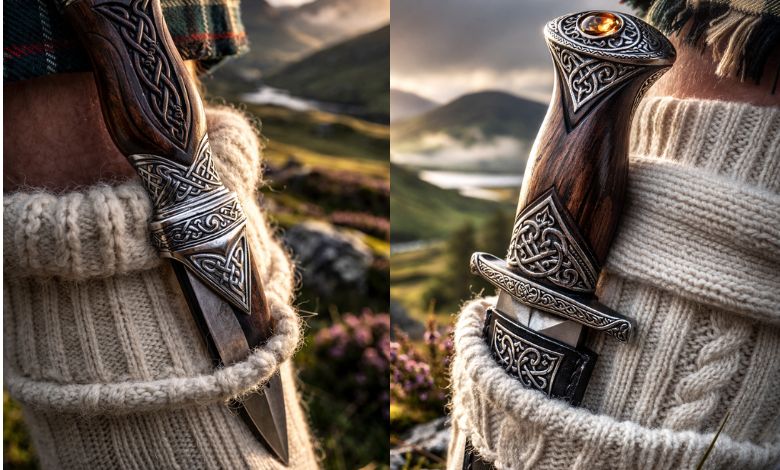
When it comes to the use of the Sgian-dubh in the current era or modern Scotland, it is a purely decorative ornament in Scottish dresses. Its primary purpose today is to honor and celebrate Scottish tradition and culture. Recently, there have been notable efforts to revive its practical use in outdoor activities.
Moreover, some restrictions and legislation are imposed on carrying traditional dirks, as you can keep them as part of an outfit, not as a weapon. Similarly, you cannot keep them in your handbag while traveling on an airplane; instead, they should be placed in luggage.
Interesting Facts and Myths About the Scottish Dirk
Sgian-dubhs have many facts and myths that you must know to clarify things about them. First overview the facts, then we will highlight myths.
Interesting Facts About Scottish Dirks
- The Sgian-dubh was first called ”ballock dagger” and was first used in the 17th century.
- Its use was common in close-quarters fighting, often paired with a broadsword or claymore.
- Scots used these knives as a practical item as they were not only weapons.
- After the Battle of Culloden, the Scottish protocols required depositing any weapon, including the sgian-dubh.
Myths About Sgian-dubh
- Scottish dirks were used as only the weapons. It is a myth, as Scots used it as their everyday item as well.
- It is often thought its name means “black knife” because of its color. In reality, the initial objects were dark-colored without any particular shade.
- Showing it in the socks is a threat. This statement is not right because it symbolizes tradition and bravery.
- Carrying daggers in public is not allowed. You can carry, but only for good reasons.
Buy Highly Crafted Sgian-dubh at The Utility Kilt
Are you looking to buy a highly crafted Sgian-dubh for the next event? Go nowhere and consult the team of The Utility Kilt to buy one. We have an online, high-reputed store based in the USA and dealing in Scottish kilts and their accessories, including traditional dirks. All of our products are made with premium-quality materials and are available at affordable prices. So, visit us right now and shop excitingly.